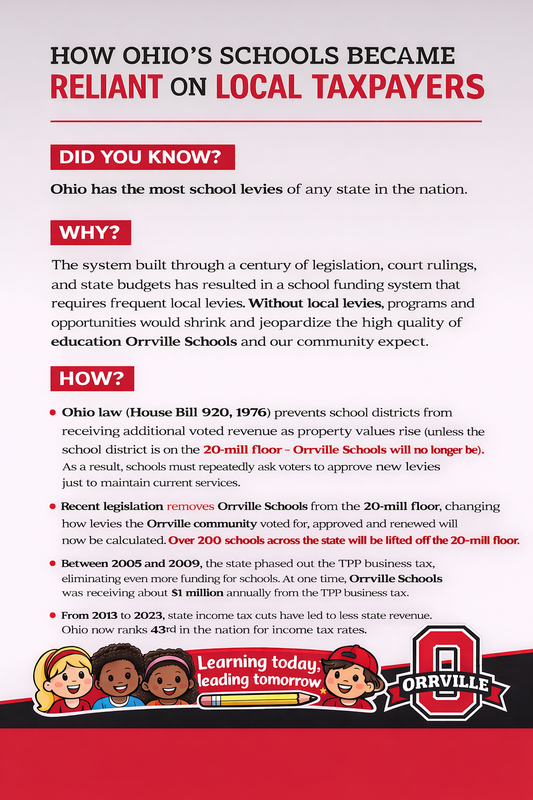
Over time, Ohio’s public school funding system has shifted more responsibility to local communities. Today, Ohio has more school levies than any other state, and districts increasingly rely on local voters to maintain programs and services students depend on.
How Did We Get Here?
Several long-standing policy decisions have shaped this reality:
House Bill 920 (1976) prevents school districts from receiving additional voted revenue when property values rise. While home values may increase, school funding from voted levies does not grow with inflation unless voters approve new levies.
State tax changes have reduced available revenue. Between 2013 and 2023, Ohio significantly reduced income taxes, resulting in lower overall state revenue. Ohio now ranks 43rd in the nation in income tax rates.
Loss of business tax revenue. Between 2005 and 2009, the state phased out the Tangible Personal Property (TPP) tax, eliminating a major funding source for schools across Ohio.
A Recent Change with Statewide Impact
Recent legislation has brought another major shift. More than 200 school districts across Ohio—including Orrville—will no longer be on the “20-mill floor.”
Removing the 20-mill levy alters the calculation of existing voter-approved levies and further restricts a district’s ability to keep up with rising costs without seeking voter approval again.
What This Means for Orrville Schools
These changes do not reflect local spending decisions or community support. Instead, they highlight how state-level funding policies increasingly require school districts to rely on local levies just to maintain current educational opportunities.
Orrville City Schools remains committed to being transparent about school funding and to working with our community to ensure students continue to receive a high-quality education—today and into the future.